english
news
films in production
films in development
A Natural History of Laughter
The documentary " A Natural History of Laughter" directed by Jacques Mitsch was selected in the Film & Science Amsterdam Festival which is organized by the French Institute in the Netherlands and will be broadcast on Saturday April 14th, 2012 at NEMO science center.
![]()
For a basket of Truffles
Sylvestre Meinzer’s documentary will be broadcast on Saturday March 17 at 4:20 pm at the Institut de Géographie of Paris during the Festival Territoire en Images.
![]()
Neuromarketing, citizens under the influence?
Laurence Serfaty’s documentary will be broadcast on Thursday March 15, 2012 at 6:00 pm during the event « Le Bar des Sciences » organized by the Scientific Culture Division of the University of Montpellier.
More information on www.barsciences.fr
It will also be broadcast on Thursday March 29, 2012 at 9:00 pm at The Royal
in Gap.
More information on http://gsa05.fr
![]()
quai Branly Museum
Design and production for the quai Branly Museum (2010-2011).
Series of films for « Lapita », « Baba Bling », « Dans le blanc des yeux »,
« Orient des Femmes », « Dogon », « Outre-Mer » and « Maya » exhibitions.
![]()
VEOLIA
Altomedia is currently producing 4 corporate films for the series « Scientific Chronicles » broadcast on Veolia Environnement ‘s website.
Already online: « Revolutionnary wastewater treatment platform », « Smart Grids », « Public transports: Information systems of the future »
![]()
Conservatory for Music and Dance of Merignac
Along with the agency Christian Menu Architecture, Altomedia was chosen for the multimedia design and production for the new Conservatory for Music and Dance of Merignac.
![]()
![]()
DVD György Sebök, music as a mother tongue
György Sebök was a great teacher. One of those who liked suggesting a path and let time do the rest. You had to listen attentively when he started to analyse your touch because his words were essential and would impact your interpretation even many years later. For the 10th anniversary of his death,
Altomedia pays tribute to György Sebök through a documentary made of unreleased interviews and footage of masterclasses in Ernen (Switzerland).
![]()
![]()
DVD « György Sebök, a music lesson »
György Sebök is an atypical, complex and secret character. His culture, humanism and his deep musical thinking fascinate immediately. Filmed during his yearly master class in the small Swiss village of Ernen, this documentary highlights some of the multiple facets of his personality.
- DVD available on sale
![]()
![]()
DVD « János Starker, a music lesson »
Underneath the apparent aloofness of the Hungarian cellist János Starker, lies
a profound sensitivity to music and a warm generosity. His elegance springs from his deep sense of rigour and asceticism. Both in teaching and in performance he is extremely mindful of every aspect of playing: the position of the body, breath, movement and sound... His devotion to teaching provides the key to his philosophy and vision of music.
- DVD available on sale
![]()
![]()
DVD « Alzheimer, living until the very end »
Carpe Diem is the story of the staff and residents of medical establishments hosting patients with Alzheimer’s. Carpe Diem is the name of such a unit in Quebec. Its philosophy, elaborated by director Nicole Poirier and her staff over the years, is based on the idea of “building a beautiful day everyday.
- DVD available on sale
![]()
![]()
Earth Architecture
Nearly three billion people on six continents live or work in buildings made of earth, which represents one half of the population worldwide. While the vast legacy of traditional and vernacular earthen construction has been widely discussed, little attention has been paid
to the contemporary tradition of earth architecture. The author Ronald Rael, founder of Eartharchitecture.org, provides a history of building with earth in the modern era, focusing particularly on projects constructed in the last few decades that use rammed earth, mud brick, compressed earth, cob, and several other interesting techniques.
![]()
![]()
A Cabaret in Shanghai
After a four-year triumphant tour of his first show “Paris Plume” in China, Asia and Middle East, Carl Clérico, Lido’s former manager and grand-son of the famous cabaret’s creator, has embarked into a new adventure: put up a permanent variety show in China, staging Shanghai
in the 1920’s, in a cabaret located at the heart of the business quarter with an all Chinese artistic team.
![]()
![]()
Welcome in Anthropocene (52’)
Human beings have become the main geological force on Earth.
Officially and for the past 10 000 years, we’ve been living in « holocene »,
a warm period with
a stable temperature. But for the last 200 years, mankind has so profoundly modified the earth that some scientists consider that we’re now living in a new geological era they propose to call
« anthropocene », the human era.
Now, would this be a pure scientist whim? An expert quarrel? Absolutely not,
for the acceptance of a new geological era would represent a key moment
in the history of science, a symbol that would dramatically change the relation between the human beings and the planet they inhabit. We may be on the eve
of a behavioural revolution among Homo Sapiens.
![]()
This 52 mn film will follow the debates, sometimes the quarrels of those who think that we are already living in « anthropocene ».
![]()
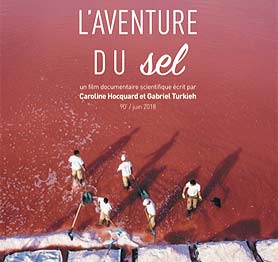
Of Salt and Men (4 x 52’)
Telling the story of salt is highlighting the relations between the human beings, between Men
and Nature. Not only we tackle the story and the development of Sciences and Technology but also the economic, social and political evolution of men in their struggles, their successes
and their sufferings.
In this documentary series (3 or 4 x 52’), the aim is to tell the story of salt first and foremost
in its relation with our species.
This will give us the opportunity to come across the most sublime landscapes of our planet, to discover those men and women harvesting salt with ancestral or modern techniques and to build the story of the planet through the story of salt.
1. Salt, sea and sun. The main story of this first film will take place in France and Benin and will highlight the connection between natural requirements and production techniques.
2. For a handful of salt. The main story of this second film will take place in India and will allow us to talk about the salt as an instrument of constraint and political resistance.
3. Engineering salt. The main story of this third film will take place in the United States. It will unveil the evolution in the uses of salt and its role in industrial societies.
4. Salt in social affairs. The main story of this fourth film will question the social and economic stakes of the business of salt in Nigeria.
![]()